Obituaries: Mariposa Folk Festival Co-Founder Ruth Jones McVeigh, Founding Grateful Dead Member Bob Weir
This week we also acknowledge the passing of Toronto musician and composer Bob Stevenson, influential New York filmmaker Amos Poe and English bassist Andrew Bodnar.
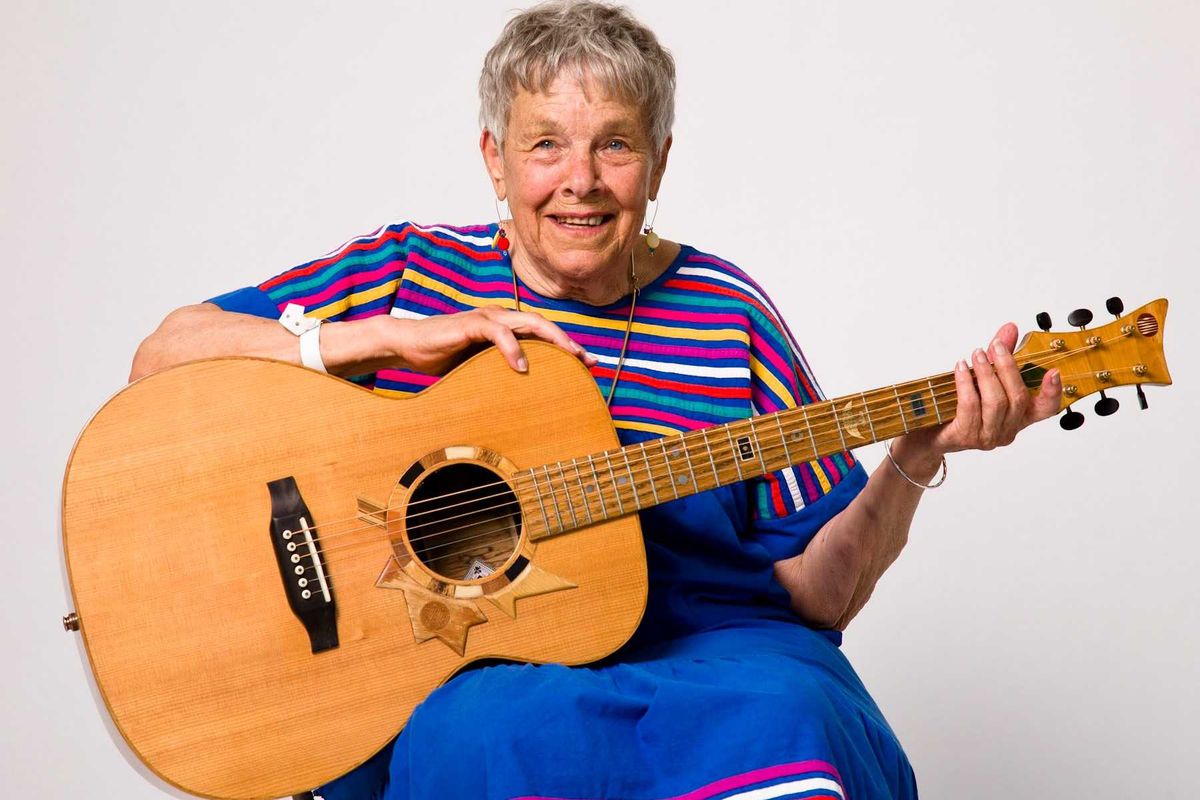
Ruth Jones McVeigh
Ruth (Major) Jones McVeigh, an author, journalist and a writer, journalist, and cultural builder best known as co-founder of Canada's legendary and long-running Mariposa Folk Festival, died on Jan. 7, at age 99.
In its obituary, CBC identifies Jones McVeigh "a driving force behind the creation of the enduring, community-oriented annual musical gathering that's withstood location changes and financial challenges to become one of the longest-running folk festivals in North America.. Gordon Lightfoot, Joni Mitchell, Leonard Cohen and Bob Dylan are among the scores of artists who attended the festival since its founding in 1961 and graced its stages."
Her official obituary reports outlines her influence:
"Together with her husband, Casey Jones, and her brother, David Major, Ruth helped establish the festival in its earliest years, laying the foundation for what would become one of Canada’s most influential and beloved folk music gatherings. Their shared vision helped create a lasting celebration of music, storytelling, and community that continues to resonate nationally and internationally."
Jones McVeigh began her writing career as a cub reporter at the Halifax Herald and Mail and went on to write entertainment reviews, feature articles, and opinion pieces for publications across Canada, including the Toronto Star, newspapers in Halifax and Toronto, and Western Living magazine.
She was also the author of two non-fiction books, including Fogswamp (published 1976 by Hancock House), Close Harmony (published 1984 by Theytus Books) and Shifting Ground, among others.
It is her pivotal role in establishing the Mariposa Folk Festival for which Jones McVeigh will best be remembered. In the festival's online tribute, current Mariposa Folk Festival president, Pam Carter says that "without Ruth we wouldn’t have this event."
Michael Hill, a former artistic director of Mariposa, also wrote a book about its storied history, The Mariposa Folk Festival –A History. He says "It has just grown to be such a cultural phenomenon that I think most people do know — at least they've heard of -- Mariposa, if they haven't attended it. And that's all thanks to Ruth."
The Mariposa obituary recalls that "a passionate fan of folk music, she and her former husband Dr. Casey Jones started the Mariposa Folk Festival in 1961. Ruth grew up playing the piano and even throughout the Great Depression her mother would find ways to pay for her lessons. A native of Nova Scotia, Ruth moved to Orillia, Ontario with her husband in the late 1940s to raise their family. Ruth was not only a mother and wife but a decorator, gardener, and renovator.
"After attending a meeting held by the Chamber of Commerce pushing small towns to find their 'tourism hook,' Ruth was inspired to find Orillia’s. As she lay in bed sick one day she thought of the idea of creating a folk festival for her sunshine town."
In an interview with CBC in 2010, for a feature on the 50th anniversary of Mariposa, Jones McVeigh recalled that "I was living in Orillia, which was a much smaller and much quieter little town than it is now. We went to hear a talk by John Fisher at the local Chamber of Commerce…he was known as Mr. Canada then. One of the things he said was that every small community should have a hook to hang tourism on. I put that together with the fact that I loved to go to folk festivals in Toronto, and I thought maybe Orillia needs something to wake it up."
"From that spark, Jones McVeigh and a small group of colleagues, including her husband, Dr. Casey Jones, tackled the idea of creating a summer folk festival in their small town with genuine passion and energy. Despite many obstacles, they pulled it off, and the Mariposa Folk Festival is their rich legacy."
Pam Carter commented, "A strong woman with an inspiring vision and plenty of determination Ruth worked tirelessly to get the word out about Mariposa." Using some of their own savings, Ruth and Casey Jones started planning for the first festival to be held in the summer of 1961.
Carter states that "She sent letters, wrote press releases, gave interviews, and even created a promotion on all milk deliveries to summer cottages to ensure her project was a success. Needless to say Ruth created and fostered an atmosphere that made Mariposa a festival that audiences from all over looked forward to. Not only did Ruth dedicate her finances and time she made sure that the festival highlighted an all-Canadian line-up. Ruth’s love for her country and folk music were the perfect inspiration."
Given her leadership role in launching Mariposa, it was entirely fitting that Jones McVeigh cut the ribbon to open the first festival, on August 18, 1961.
As Hill points out in his history, luring top American folk stars to an unknown festival proved impossible in that first year, but Jones McVeigh helped assemble a strong all-Canadian lineup for the premiere event. That grouping included The Travellers, Jean Carignan, Alan Mills, Jacques Labrecque, Bonnie Dobson, and an up-and-coming duo called Ian and Sylvia. Ian Tyson was actually recruited to design the first Mariposa logo and poster, and his downtown Toronto apartment hosted frequent festival-related meetings.
Though it was recognized as a major success musically, the first Mariposa Folk Festival ran into financial trouble. As Mike Hill’s book notes, “the performers were not paid extravagantly, yet money still ended up being owed for advertising, equipment rental, and legal fees. Dr. Jones had footed many of the bills using his family’s personal savings, even going so far as to take out a mortgage on his lakeside home. He never recouped those expenditures."
These financial pressures led Jones McVeigh, and the original Mariposa board of directors to, in February 1962, accept an offer by Toronto entrepreneur Jack Wall to buy the rights to the festival for just $2, on condition that he’d take care of outstanding bills. Jones McVeigh and her colleagues retained artistic direction for the second festival, held later that year.
In 1964, Jones McVeigh, now separated from her husband, left Orillia to live, briefly, in Toronto and then New York City, then moved west to Vancouver, where she concentrated on her writing.
The Mariposa obituary notes that "Throughout her time living in various parts of the world she was always in touch with the Mariposa Folk Festival and came to its rescue in 1987. When Ruth heard the festival was at risk, she advocated for it to open its gates for another year. Her sheer presence at a festival general meeting in Toronto changed the entire outcome – once again, Ruth had saved Mariposa."
"Ruth will always be remembered for her attendance at the 2005 festival when the Hall of Fame was introduced and she was an honorary inductee. The smile beaming from her face as she held her plaque was a reminder of her appreciation for music and how much the festival truly meant to her."
"In her later years Ruth did everything she could to attend the festival when she couldn’t drive herself. One year she even hitched a ride to Orillia with a performing musician. While attending the 2013 festival she recounted, 'A lot of the stuff that’s happening politically and sociologically will be translated into folk music because that’s what it is. It has variations.'
In an interview with the Orillia Packet and Times in July 2010, Mariposa’s 50th anniversary, Jones McVeigh reflected on the festival’s history. “I honestly wasn’t too surprised when the first one was a success, but to ask me if I could visualize myself being there 50 years later, with an audience ten times as big, no I could not have imagined that … I’m overjoyed and I think it’s wonderful.”
Mariposa launched its Hall of Fame in 2005, and Ruth and Casey Jones were rightfully included in the first list of seven inductees. “Almost all showed up for the ceremony,” Hill recalls. “Such an interesting and dynamic group, entrepreneurial and hard-working. You could see how they were able to put this together.”
Jones McVeigh kept a diary during those days of the creation of Mariposa, and that is part of her personal archive that was acquired by York University in Toronto and is now on digital display there.
The Mariposa Folk Foundation is taking donations in memory of Jones McVeigh.
Bob (Robert W.) Stevenson, a noted Toronto musician and composer on the Toronto scene, died in early January, at the age of 71, of cancer.
He played and composed in a wide range of musical settings. In its obituary, JazzInToronto remembers that "Stevenson worked with Arraymusic, New Music Concerts, Hemispheres Music Projects, Fifth Species Counterpoint, Tapestry New Opera Works, the Flying Bulgar Klezmer Band, The Red Rhythm, The Sonny Balcones, The Holy Gasp and many others. Besides being a great talent, he was a charming and friendly individual."
In a 2001 Composer Showcase profile, the Canadian Music Centre (CMC) noted that "Stevenson has been active as composer and clarinetist in the Toronto new music scene for many years. After studying at the Royal Conservatory of Music (Toronto) and the University of Western Ontario, he embarked on a career that has seen him function as artistic director of Hemispheres, conductor of the Fifth Species Counterpoint ensemble, clarinet player in and artistic director of Arraymusic, and co-artistic director of the musicdance orchestra.
"As a composer he has worked with the Physical Theatre Company, choreographer Bill James, the Evergreen Club Gamelan, and Art in Open Spaces. His list of compositions includes works for a variety of unusual chamber music ensembles, and Nostalgia, an opera in two acts."
During his time at Arraymusic, Stevenson was a passionate advocate for the retention of classical music on the CBC, as evidenced in this 2008 video.
Benjamin Hackman, leader of Toronto group The Holy Gasp, offered this tribute to Billboard Canada: "I met Bob Stevenson on a Saturday night at La Palette in Toronto in 2012. I was a newly matriculated member of Michael Louis Johnson’s brass band, Rambunctious, hired to play percussion, and eager to prove whatever it proves when a young player plays amongst his elders. Bob’s spot was next to mine, but one needn’t have stood as close as I to recognize his genius.
"He was a man of many faces—not to be mistaken for a man of many masks, for he was, in fact, brutally sincere, and the Bob one saw largely depended upon the Bob one sought. To most of us millennials in the band, Bob was surly and standoffish. To approach him was to approach a man entirely uninterested in talking, and seemingly irritated to be spoken to at all.
"It took about 20 seconds for me to get the guy to even turn his head and acknowledge me, and when he finally did, between his coke bottle glasses and wandering eye, I had no earthly idea if he was even looking at me. But I was obsessed. And gig after gig I bugged him until he cracked a smile and agreed to be my friend. His was a friendship worth fighting for. For serious art and serious artists, he shared a great deal of himself, and with him came a wealth of warmth and wisdom. Though he was 32 years my senior, we grew closer and closer over the years, until he revealed himself to be a deceptively chatty individual, sometimes calling me on the telephone nearly every day just to talk. As the years went on, we collaborated more and more, too.
"Bob began contributing to my own ensemble, The Holy Gasp, around 2014, and has the distinction of being the group’s most prolific collaborator, having provided clarinets in studio for our first two records, 2015’s The Last Generation of Love, and 2018’s The Love Songs of Oedipus Rex, as well as an assortment of woodwinds for our live film score performances of The Freshman for The Toronto Outdoor Picture Show. In 2020, he co-composed Mmm Urkh But with me, a musical narrative for bass clarinet and percussion, and conducted our 45-person orchestral recording of …And the Lord Hath Taken Away in 2022.
"He continued to be surly. He continued to be sincere. His contribution to music, and to my memory, is indelible. I’m going to miss him for a long, long time."Many other notable local musicians paid tribute to Stevenson on Facebook.
Michael Occhipinti: "Very sorry to hear this, I heard Bob a lot over the years with Arraymusic, and always enjoyed talking to him, and I certainly got to hear him play some really interesting music!"Richard Underhill (Shuffle Demons): "Bob was great, a wonderful musician and a truly excellent character!"
Jane Bunnett: "l am so very saddened to hear of the passing of the great Bob Stevenson. I went to Oakwood Collegiate with Bob...and later played with him in many ensembles. He was an amazing artist, with an incredible wit, a wicked sense of humour. Such a pleasure to be around...inspiring always.. and a deep thinker. What a loss."
Ori Dagan: "Bob was a wonderfully bold and inventive composer of new music and he was often heard improvising soulfully on clarinet and saxophone around the city. I loved hearing Bob at The Communist’s Daughter with The Red Rhythm. I was lucky to sing with this group a number of times and his solos were always a highlight of the afternoon. Condolences to all who knew and loved Bob, who will be sorely missed."
International
Bob Weir, a renowned guitarist and legendary founding member of the Grateful Dead, has died at age 78, of cancer.
Weir’s death was confirmed Saturday (Jan. 10) by a statement published on his official social media accounts. “It is with profound sadness that we share the passing of Bobby Weir. He transitioned peacefully, surrounded by loved ones, after courageously beating cancer as only Bobby could. Unfortunately, he succumbed to underlying lung issues,” said the statement, which can be found on Weir’s Instagram.
The note continued, in part: “For over sixty years, Bobby took to the road. A guitarist, vocalist, storyteller, and founding member of the Grateful Dead. Bobby will forever be a guiding force whose unique artistry reshaped American music. His work did more than fill rooms with music; it was warm sunlight that filled the soul, building a community, a language, and a feeling of family that generations of fans carry with them. Every chord he played, every word he sang was an integral part of the stories he wove. There was an invitation: to feel, to question, to wander, and to belong.
"Bobby’s final months reflected the same spirit that defined his life. Diagnosed in July, he began treatment only weeks before returning to his hometown stage for a three-night celebration of 60 years of music at Golden Gate Park. Those performances, emotional, soulful, and full of light, were not farewells, but gifts. Another act of resilience. An artist choosing, even then, to keep going by his own design."
"He often spoke of a three-hundred-year legacy, determined to ensure the songbook would endure long after him. May that dream live on through future generations of Dead Heads. And so we send him off the way he sent so many of us on our way: with a farewell that isn’t an ending, but a blessing. A reward for a life worth livin’."
A Billboard obituary notes that "in a career spanning six decades, Weir was key to developing the Grateful Dead from garden-variety psychedelic rockers as the Warlocks to godfathers of the jam band genre. Weir’s loping, syncopated guitar style, modeled after “McCoy Tyner’s left hand,” may not have made much sense in a traditional rock band, but to the Dead, it was a crucial puzzle piece. His decades-long bandmate, bassist Phil Lesh — who died in 2024, at age 84 — called him 'a stealth machine' in a 2012 feature in The New Yorker.“
"Raised by adoptive parents in San Francisco, California, Weir met his future Dead bandmates in 1964. In high school, he began music lessons at the feet of Jerry Garcia, who then taught guitar and banjo in Palo Alto. Weir eventually was recruited for Garcia’s band, the Mother McCree’s Uptown Jug Champions — featuring bassist Lesh, keyboardist Ron “Pigpen” McKernan and drummer Bill Kreutzmann. Inspired by The Beatles’ rise, the band pivoted to rock and roll, briefly playing out as the Warlocks before discovering that another band had taken the name."
"The newly christened Grateful Dead released their self-titled debut in 1967, featuring R&B standards and originals with a lysergic tint, but they soon revealed themselves as a much different beast. Eager to capture their swirling live energy, they released Live/Dead in 1969.
"The Dead went on to release an ocean of official live albums, which only scratched the surface: a massive 'taper' subculture formed around their fan-traded bootlegs. As they veered into space-rock territory, Weir kept the sets grounded with cowboy songs and Dylan covers. He released his solo debut, 1972’s Ace, with the rest of the Dead as his backing band.
The Grateful Dead found unexpected pop success by way of 1987’s “Touch of Grey,” a friendly ode to survival from their eventually double-platinum-certified In the Dark LP that peaked at No. 9 on the Billboard Hot 100.
Billboard notes that "The Grateful Dead got by and survived through health scares and drug issues, and remained together and vital until Garcia’s death in 1995, performing over 2,300 concerts and selling over 35 million albums. After they disbanded, Weir stayed busy with band offshoots like The Other Ones (later known as The Dead), Furthur, RatDog and more."
In later years, Weir performed Dead material on the road with Phil Lesh, Mickey Hart, Bill Kreutzmann, new collaborator John Mayer and more as Dead & Company.
An artist with a social conscience, in 2017, he was appointed a United Nations Goodwill Ambassador for his efforts to fight climate change while serving on the board of the company Tribal Planet. “I’d also like to see people reflexively consider the good of the planet in the choices they regularly make,” he told Billboard in 2017.
Dead & Company toured through 2023, then had successful residencies at The Sphere in Las Vegas. Weir brought the group to San Francisco’s Golden Gate Park in August 2025 for a three-show run celebrating 60 years since the Grateful Dead’s 1965 debut. He’d been diagnosed with cancer and had begun treatment just a few weeks prior to the Golden Gate Park shows.
As news of Weir's passing spread, such major music stars as Don Felder, Michael Franti, Slash, Les Claypool (Primus) and Sean Ono Lennon paid tribute, as reported in Billboard.
On Facebook, acclaimed Toronto rootsy singer-songwriter Julian Taylor offered this tribute: "He’s one of my biggest heroes and I love him. I met Bob once and felt so lucky to. It was actually pretty funny. It was when Allison Russell invited myself and Logan Staats to LA to perform at the Robbie Robertson Tribute.
"I was side stage talking to Jim James when Bob Weir caught our eye and came over to say hello. I got so excited. I thought he was coming to say hello to me, but he was obviously coming to greet Jim. I held out my hand to shake his and he reached out to shake Jim James’s hand, and I got caught in the crossfire. It was kinda like a zigzag, pretty awkward. Bob looked at me like 'who is this weird guy?'
"Later that night, we all got on stage and everyone sang 'The Weight' with Mavis Staples. It was the finale and after the song was done he hugged me. This one hurts."
Andrew Bodnar, an English bass player known for his work with Graham Parker and The Rumour, died on Jan. 5, at age 71.
Bodnar grew up in Clapham, South London. After meeting drummer Steve Goulding, the two began playing together as a rhythm section while still at school. They spent their teenage years auditioning and busking whenever they could, and were gigging around London with a Cajun-influenced band called Bontemps Roulez just prior to forming The Rumour in 1975.
He played with Graham Parker and The Rumour from 1975 to 1980, a period during which their pub rock focused sound proved very popular in Britain. He also played on three albums credited to The Rumour, and on five later solo Graham Parker albums
Bodnar's other credits include playing the distinctive reggae-flavoured bassline on "Watching the Detectives," a hit for Elvis Costello, and for playing bass on and co-writing Nick Lowe's "I Love the Sound of Breaking Glass", which he co-wrote with Lowe and Goulding.
Other album credits include work with Gay & Terry Woods, Desmond Dekker, Garland Jeffreys and The Pretenders, and he also toured with The Thompson Twins. In 1999, Bodnar made his solo debut with a five-song EP, Obsessed.
On Facebook, TalkBass.com reported that "Bodnar eventually semi-retired from music and became a librarian, but continued play, write and record."
Read an interview with Bodnar about his career here.
Amos Poe, a New York City-based No Wave director and screenwriter, described by The New York Times as a pioneering indie filmmaker, died on Dec. 25, at age 76, of colon cancer.
Poe was born Amos Porges in Israel, where his parents had immigrated from Europe. His family moved to East Meadow, New York, when he was eight years old. He attended the State University of New York at Buffalo, but dropped out in 1972.
His independent film work had a major impact on punk music, especially in New York City. His 1976 film The Blank Generation (co-directed with Ivan Král) is considered one of the earliest punk films. The acclaimed film features performances by Richard Hell, Talking Heads, Television, Patti Smith and Wayne County.
He was also associated with the birth of No Wave Cinema due to films such as Unmade Beds (1976), featuring Duncan Hannah and Debbie Harry; The Foreigner (1978), featuring Harry, Eric Mitchell, and Anya Phillips; and Subway Riders (1981). During this time he was also the director of the public-access television cable TV show TV Party ,hosted by Glenn O'Brien and Chris Stein of Blondie.
In 2008, he wrote the screenplay for the Amy Redford film The Guitar and and in 2003 he directed the documentary Steve Earle: Just an American Boy. Check out a filmography here.
Poe taught filmmaking at New York University's Tisch School of the Arts and at Brooklyn College's Feirstein Graduate School of Cinema, and, in 1980, at NSCAD in Halifax.
Veteran Toronto music and film promoter Gary Topp had a long friendship and working relationship with Poe, which he described in this Facebook tribute. "Amos Poe was a giant of underground filmmaking. He was one of the '70s' groundbreaking artists who culturally changed New York and, I dare say, the world. His early films, Night Lunch and Blank Generation, inspired me to build a stage in my cinema so I could bring the Ramones to Toronto. He then introduced me to Willy DeVille, a man I adored."
"He really did kickstart my career in music presentation. Amos and I stayed in touch for fifty years, I reported everything I was up to and even through his over-lengthy illness, he never failed to respond with love and enthusiasm. He was kind, gentle, spirited and a gentleman. Of the people I’ve met over the years, few have been as humanly beautiful. Amos Poe hijacked my brain. I’m sad today but relieved for him and his loved ones. I will always be indebted to him for being there at the start of my music career and for being a kind and caring friend."
Read a New York Times obituary here.