Canadian and Australian Music Rights Organizations Release Joint Statement on AI and Copyright
With Prime Minister Mark Carney visiting Australia, SOCAN CEO Jennifer Brown and her Australian counterpart Dean Ormston of APRA AMCOS united to oppose copyright exceptions for AI training.
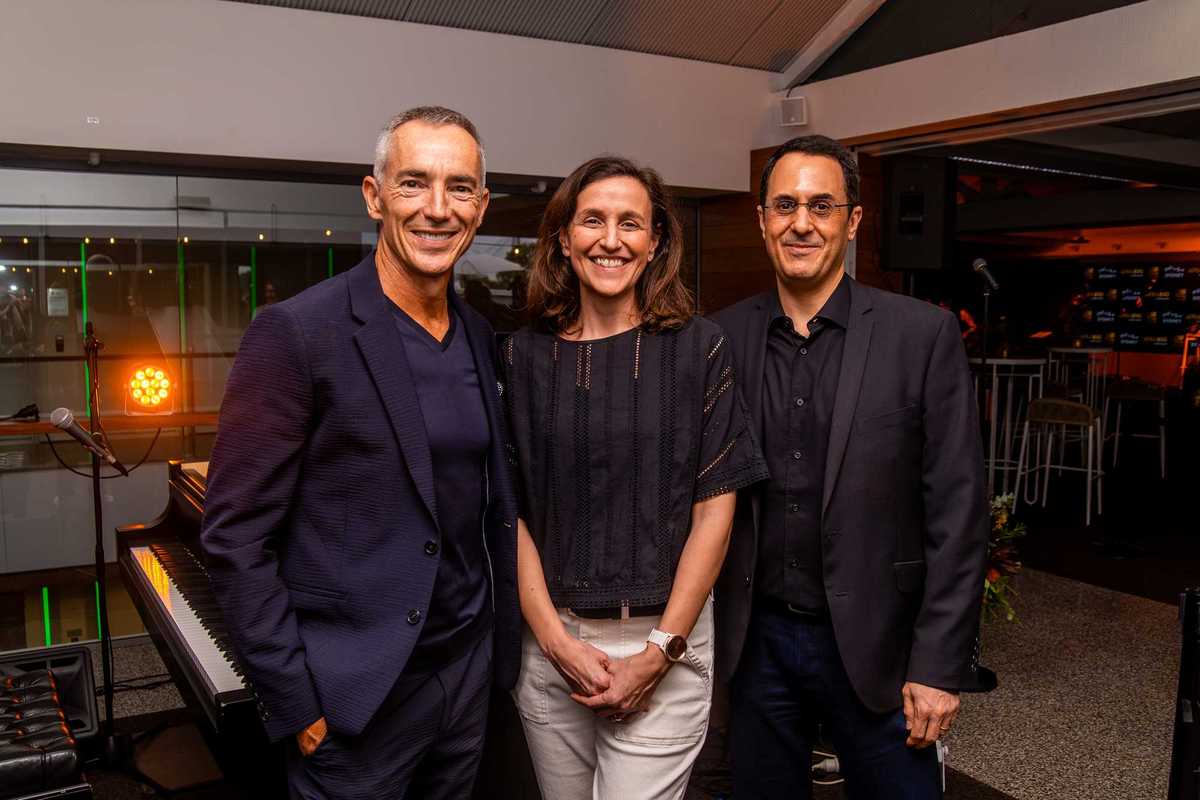
(L-R) Dean Ormston, CEO APRA AMCOS; Jennifer Brown, CEO SOCAN; Gadi Oron, Director General, CISAC
Canadian Prime Minister Mark Carney visited Australia this week, creating many headlines on two different sides of the world. Simultaneously in Sydney this week was another notable Canadian, SOCAN CEO Jennifer Brown, and her visit also made a mark.
Brown was attending the board of directors meeting of CISAC (the International Confederation of Societies of Authors and Composers), hosted by Australasian performing rights society APRA AMCOS as part of its centenary year. She and her Australian counterpart, Dean Ormston, CEO of APRA AMCOS, took advantage of the timing of Carney's visit to release a joint statement on creative industries and artificial intelligence.
Their statement reads, in part: "Today, as Prime Minister Albanese welcomed Prime Minister Carney to the Australian Parliament, he said it plainly: 'As two middle powers in an era of strategic competition, Australia and Canada must seek and create new ways to stand with and for each other.' Prime Minister Carney was equally direct about the stakes: that nations like ours must work together on the development of Artificial Intelligence or risk being caught 'between the hyperscalers and the hegemons.' We agree on both counts, and we believe the creative economy is where that solidarity must be tested and proved."
"We [SOCAN and APRA AMCOS] collectively represent almost 400,000 songwriters, composers, and music publishers across Australasia and Canada. The shape of that framework matters enormously. It will determine whether AI development generates broad cultural and economic returns, or whether those returns flow overwhelmingly to a small number of global technology platforms at the expense of the artists whose work made AI possible."
While they are supportive of AI development, they note, there is an urgent need for a licensing framework. There can't be a legal exception to copyright for AI training.
"Middle-power nations are uniquely placed to answer this question. Australia has already demonstrated that: becoming the first country in the world to rule out a copyright exception for AI training, and beginning work on a practical licensing framework instead. Canada is engaged in the same contest. Both countries understand that the choice is not between innovation and creator protection: it is a false choice, and a self-interested one, advanced by those who prefer to avoid the importance of artists and creators in the technological development of AI."
"APRA AMCOS and SOCAN have each spent a century navigating technological change on behalf of creators, from radio to streaming, and now to AI. The licensing infrastructure exists. The expertise exists. The partnerships between our two governments create the right conditions to build the frameworks that make it work."
The challenges posted by AI to the music creators belonging to both performing rights societies has clearly been top of mind to both APRA AMCOS and SOCAN, and they are pledging to co-operate on this issue.
Last month, SOCAN launched a national campaign, urging the Canadian government to eliminate copyright exceptions that permit free and unauthorized use of copyright-protected works for AI training — prioritizing human-created music. The campaign quickly elicited the support of prominent Canadian artists and organizations, including Sarah McLachlan, Barenaked Ladies' Ed Robertson, Elisapie, Dan Mangan, Mac DeMarco, Leith Ross, BMG Music Publishing, Nettwerk Music Group and more.
Jennifer Brown told Billboard Canada that "This is a defining moment for Canada. AI companies are taking copy-protected works without consent, and the impact is being felt across the music industry. Music creators cannot compete in a system that devalues human expression while AI companies profit from the unlicensed use of their work.”
In addition to protecting creative integrity, the campaign addresses policymakers directly, “at a critical moment,” demanding that the government protect human expression, require transparency from AI companies and ensure clear labelling of AI-generated outputs.
The campaign follows the news reported by Billboard Canada last October that three performing rights societies — SOCAN, ASCAP and BMI — have adopted policies that accept registrations of musical compositions partially generated using AI tools. In this case, a partially AI-generated musical work is "one that combines elements of AI-generated musical content with elements of human authorship" and does not include musical compositions that are created entirely with AI.
At the time, Jennifer Brown noted that the alignment of all three PROs "creates a legal and ethical path forward for AI in music." It's one that still puts humans first," she said. "It recognizes that music creators are embracing new tools, while reinforcing our commitment to what matters most: respect for their work and the protection of human creativity," she says. "The future of music can embrace AI and still remain deeply human.”
In a recent Billboard Canada Executive of the Week feature, Music Publishers Canada CEO Margaret McGuffin, who spoke at the House of Commons in Canada alongside Brown, argued that "There is no grey area," when it comes to copyright and AI training. "People who say there is don’t want to license. They want to avoid paying."
- Sarah McLachlan, Mac DeMarco, Leith Ross and More Support SOCAN Campaign to Stop Unlicensed AI Music ›
- SOCAN Responds to Canada's New AI Strategy, Calls to Protect Copyrighted Music | Billboard Canada ›
- La SOCAN réagit à la nouvelle stratégie canadienne en matière d’IA et appelle à renforcer la protection de la musique soumise au droit d’auteur | Billboard Canada ›
- SOCAN Teams With Musical AI to Offer 'Consent Management and Attribution' Tools For Generative AI Music | Billboard Canada ›