Hall & Oates Lawsuit Ruling: Judge Blocks Oates From Selling to Primary Wave (For Now)
The judge granted a restraining order preventing John Oates from selling his share of the duo's joint venture until an arbitrator has heard Daryl Hall's objections.
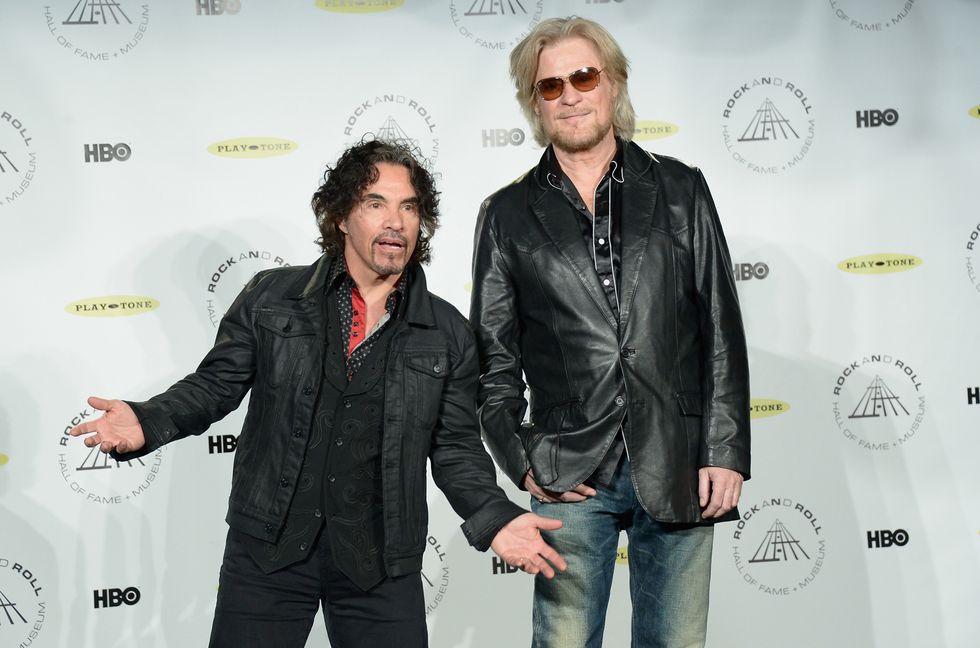
John Oates and Daryl Hall of Hall and Oates attend the 29th Annual Rock And Roll Hall Of Fame Induction Ceremony at Barclays Center of Brooklyn on April 10, 2014 in New York City.
The Nashville judge overseeing the bitter lawsuit between Hall & Oates sided with Daryl Hall on Thursday (Nov. 3) and ruled that John Oates temporarily cannot sell his share of the band’s joint venture to Primary Wave until a private arbitrator hears the case.
Hours after attorneys for the two singers squared off in court, Chancellor Russell Perkins agreed to extend an existing restraining order that’s been blocking Oates from selling his share of their joint venture to industry heavyweight Primary Wave.
Without such an order in place, Perkins ruled that Hall might face the “irreparable harm” of the sale being finalized before he is able to prove his claim that the deal violates the terms of their partnership deal.
“If the transfer goes forward before the arbitrator has an opportunity to consider and rule upon plaintiffs’ application for interim injunctive relief in the arbitration, then it could, as a practical matter, render much of the relief Plaintiffs are seeking in the arbitration ineffectual,” Perkins wrote.
The new restraining order bars Oates from completing his sale to Primary Wave until February or until an arbitrator can decide whether to impose a similar restraining order — whichever comes first.
Neither side immediately returned a request for comment on Thursday.
Hall & Oates pumped out six chart-topping singles and four chart-topping albums during the 1970s and 1980s and continued to successfully tour as recently as last year. But in early November, Hall filed a private arbitration case against Oates, accusing him of violating their partnership agreement by attempting to sell his half to Primary Wave, a prominent music company that’s purchased catalogs and other IP linked to many iconic musicians in recent years.
Fearing the deal would close before the arbitration case was heard, Hall then filed the current lawsuit in Tennessee, seeking a court order to block the sale. Perkins quickly did so, blocking the Primary Wave sale from closing until Thursday when he could hear from both sides.
At a live hearing in Davidson County Chancery Court earlier on Thursday, a who’s-who of music attorneys battled over whether to extend the restraining order. Representing Hall was Christine Lepera of the law firm Mitchell Silberberg & Knupp, who argued that it would be “most efficient” to put the sale on ice until the arbitrator could weigh in. Derek Crownover from the firm Loeb & Loeb LLP, representing Oates, fired back that no additional injunction was needed — that Hall was “not entitled to any relief at all.”
Though the case started out under seal and shrouded in mystery, the legal battle between Hall & Oates has turned increasingly public — and increasingly nasty — over the last week.
On Wednesday, Hall said he had been “blindsided” by the Primary Wave deal and called it the “ultimate partnership betrayal” by his former partner. “Respectfully, he must be stopped from this latest wrongdoing and his malicious conduct reined in once and for all,” Hall wrote of Oates.
Hours later, Oates said in his own declaration that he was “tremendously disappointed” that Hall would make such “inflammatory, outlandish, and inaccurate statements” about him. “I can only say that Daryl’s accusations that I breached our agreement, went ‘behind’ his back, ‘acted in bad faith,’ and the like, are not true,” Oates wrote.
Following Thursday’s decision, the case will now head to private arbitration, for which an arbitrator has already been selected but an initial hearing has not yet been scheduled.