Shakira Announces 2024 World Tour During Electrifying Bizarrap Coachella Performance
The Argentine artist performed a live DJ set at the Sahara Stage on Friday (April 12).
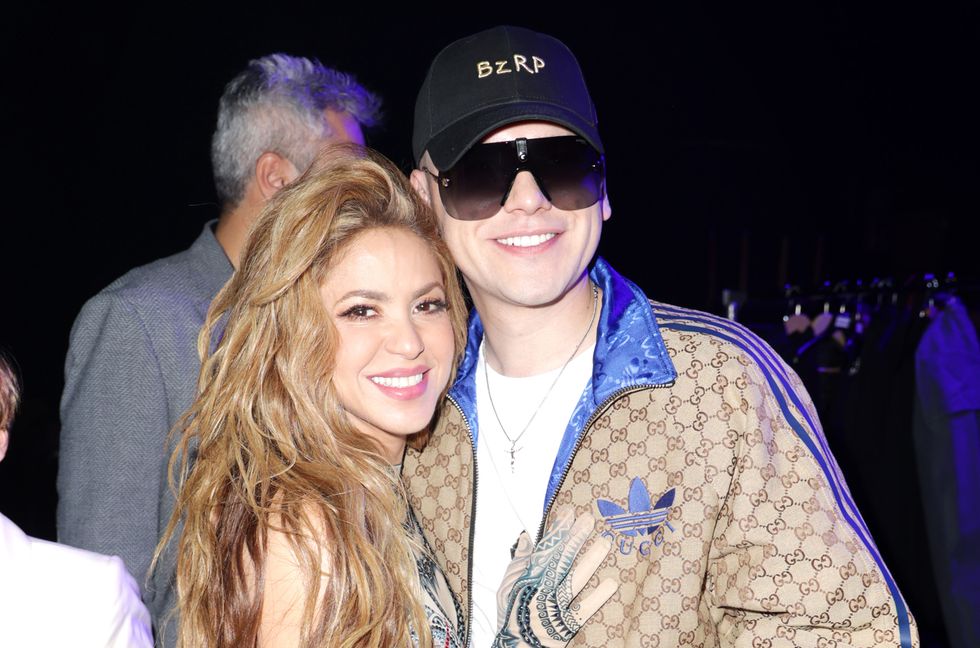
Bizarrap and Shakira perform at the Sahara Tent during the 2024 Coachella Valley Music and Arts Festival at Empire Polo Club on April 12, 2024 in Indio, California.
Bizarrap transported his “Bzrp Music Sessions” from his distinct blue-hued recording studio to the desert at the 2024 Coachella Valley Music and Arts Festival on Friday (April 12), where his special guest Shakira could not hold back from sharing major news.
Just before 8 p.m. PT on the Sahara Stage, the Argentine hitmaker arrived wearing his signature black baseball cap, large, dark sunglasses, and blue track jacket, while he was surrounded by his equipment.
His set kicked off with one of the songs that made him a viral sensation during the pandemic in 2020: “Nathy Peluso: Bzrp Music Sessions, Vol. 36.” It followed with back-to-back upbeat tracks: “L-Gante: Bzrp Music Sessions, Vol. 38,” “Ptazeta: Bzrp Music Sessions, Vol. 45,” “Eladio Carrion: Bzrp Music Sessions, Vol. 40,” “Morad: Bzrp Music Sessions, Vol. 47,” Milo J: Bzrp Music Sessions, Vol. 57” and “Villano Antillano: Bzrp Music Sessions, Vol. 51,” to name a few.
A man of few words, focusing all his energy on his DJ controller, Biza hyped up the crowd with his fist pumps and jumps. “Let’s go, Coachella!” he would scream here and there.
Most notably during his one-hour set were the vibrant and futuristic visuals and incredible light show that would change with every track and beat and seemingly took over the entire desert.
At 8:13 p.m. — just after performing his Residente-assisted “BZRP Music Sessions #49” and “Mamichula” in collaboration with Trueno and Nicki Nicole — Shakira arrived onstage for a surprise performance. On the screen: “La Loba Se Viene.”
Shakira, looking flawless and graceful as always, performed “La Fuerte,” her second collaborative effort with Biza, part of her latest studio album Las Mujeres Ya No Lloran.
“Good night, Coachella! This is amazing,” she told the crowd. “Thank you, Bizarrap for inviting me. Truthfully, it’s amazing being here with this audience, with you, my colleague, my friend.”
Dressed in a sunset ombre cutout dress, Shak then announced major news: “I have to share something today. Biza, I’m going on tour. I’m going on tour, finally…starting here, this November, this year, this city. I can’t wait. Couldn’t ask for more,” she said, as the screens displayed “Las Mujeres Ya No Lloran World Tour” in white text.
Shortly after, Shak and Bizarrap celebrated with their megahit “Shakira: Bzrp Music Sessions, Vol. 53.” The track peaked at No. 9 on the Billboard Hot 100 and landed at No. 2 on both the Billboard Global 200 and the Billboard Global Excl. U.S. It also ruled the Hot Latin Songs chart, scoring Shakira her 12th leader on the tally.
Biza then continued pumping up the crowd with his bangers, including his collaborations with Peso Pluma, Natanael Cano, Snow Tha Product, and Young Miko, to name a few. “Let’s f—ing go Coachella!” he chanted.