Paul McCartney Talks ‘Man on the Run’ Documentary: ‘What Do You Do After the Beatles?’
After a screening at the Academy Museum, McCartney and director Morgan Neville spoke about the project, which chronicles McCartney's decade after the Beatles.
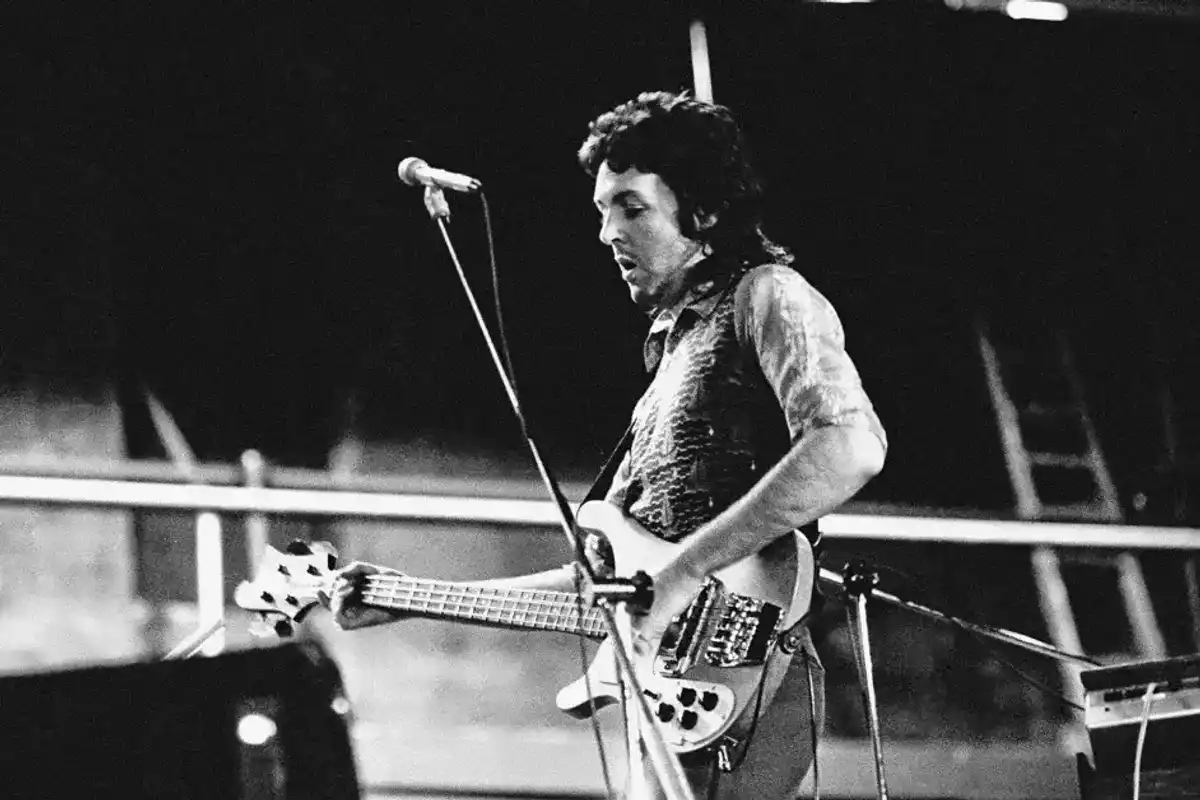
Paul McCartney rehearsing with his band Wings before their British Tour on April 7, 1973.
What can a musician do next after being in, arguably, the greatest band of all time? Academy Award-winning filmmaker Morgan Neville’s 2026 documentary, Man on the Run, seeks to answer just that. With never-before-seen footage of Paul McCartney, his family, and his second band, Wings, Neville shares McCartney’s challenging journey from Beatles frontman to soloist to leader of a new group.
Set between about 1968 and 1980, McCartney starts on his isolated Scottish farm with his wife, Linda, and growing family, wrestling with what to do with his newfound freedom. The Beatles had called it quits — it was John Lennon’s idea, says McCartney — but the world didn’t know it yet.
Over the course of its runtime, Man On The Run shows McCartney as he makes his way back to headlining arenas across America and all the bumps along the way to get there. Unflinching, the documentary does not shy away from addressing the critics’ panning of much of McCartney’s solo work, the murder of John Lennon, his brief stint in a Japanese prison and his bold choice to sue the Beatles.
Key figures like Stella and Mary McCartney, Mick Jagger, Denny Laine, Laurence Juber, Chrissie Hynde, Joe English, as well as Paul himself shared stories for the documentary. Linda, who passed away in 1998, also shared several stories via archival footage, voice-over, and photos.
The documentary, which is available now on Amazon Prime, was screened at the Academy Museum in Los Angeles on Monday (September 28), and the presentation was followed by a Q+A with McCartney and Neville, hosted by filmmaker Judd Apatow. A condensed and edited version of that conversation can be found below.
Apatow: So, Paul, when someone says, “Let’s do a Wings [documentary],” do you think, “Great, I really want to dig into that period of my life,” or, “Oh, God”?
McCartney: No, I like that period. Well, you know, now it’s a fond memory. What do you do after the Beatles? The Beatles break up. That’s been your only job you’ve ever had, and then you don’t have it anymore. It’s like you got sacked. And so that was Wings, you know—trying to figure it out. And as you can see in the film, we did well. It was kind of madcap, you know. But, yeah, no, I like that period.
Oh, and then on top of [leaving the Beatles], there was this business guy, Allen Klein, who was basically stealing from the Beatles, and I was the only one who thought that. The other guys thought, “We love him.”
Apatow: Why were they so dumb? Honestly, because I think the business people knew he was a kind of shady character.
McCartney: I’ll tell you why. Because you’d be at a meeting with him, and you’d go, “What do you want? The New York guy, what do you want? What do you want? A million dollars?” “Yeah.” “Okay, you got it.”
He just promised the earth and didn’t deliver it. But meanwhile, I could see that this was a crook. It was me against the other guys, and that was the worst thing. You know, I mean, I’d come up against the guys making music, but it was okay because you could say, “Well, I know I really think this is right,” and so on. And I did either agree or they wouldn’t, and I’d go with their version, you know. But it was relatively easily solved. This was suddenly everything we’d ever earned—everything we’d ever, all the money we’d ever earned—was going to go into this guy’s bank account, and I just really had to fight it.
Apatow: And it’s your best friends, so you’re suing your best friends
Well, that was it. I said, “Okay, I’ll sue Allen Klein. I’ll get him.” My lawyers were Linda’s dad and brother, and so I said, “Yeah, let’s go. We’ll get this guy.” They said, “You can’t, because he’s not a party to any of the agreements. The only people who are parties to these agreements are the Beatles.” They said, “So you’ll have to sue them.” I said, “Well, I can’t.” This went on for months. I said, “I can’t do it, you know. It’s just like the world will go against me, number one, and I’ll go against me, and it’s not a great idea.” So in the end, that was the only way. I had to do it.
Tons of people do amazing things when they’re really young, and then for the rest of their lives they never get close to it. Was it a terror for you?
Yeah, I think just being on my own was very scary because I’d always had the union of the group, but then I had to figure out how I would do it and make it different. That was the trick, because I thought, “Well, I could just write some more kind of Beatles-y songs, and we could imitate it. We’d be like a Beatles cover band.”
When you look back, Ram is considered a classic. A lot of people think it was even the beginning of a certain kind of indie rock and home recording. But when people attacked you for it at the time, was that devastating that people didn’t know how to enjoy it for what it was?
Yeah, I think so. I thought we’d got something special, and the critics didn’t. Critics criticize, and they criticized me. So, with all these hopes—with the young family and this record—I thought, “This is a good record.” The worst bit is, I bought into it. I listened to the critics and thought, “Maybe they’re right. I don’t know.” For years, I thought it wasn’t a very good album. Then one of my nephews came up to me one day and said, “You know, my favorite album of yours is Ram.” I went, “What?” And I suddenly liked it again.
Why do you think that period annoyed John Lennon? Was it the joyfulness of it, while he was doing Primal Scream and you were having fun? What do you think got under his skin about it?
It’s just one of those things. I mean, I loved John and love him to this day and always will. It wouldn’t matter, as it didn’t matter, what he said or did, because I’d known him since I was 15, and so he was this mad guy I knew, and I really looked up to him.
When you’re 13 and a half or something—and, when I was a little older, I was 15, and he’d be 16 and a half—there’s that kind of guy who’s cruel and witty and right on. You look up to them and say, “Wow, he’s really cool.” I always thought John was very cool, and I still do. But he could be a complete idiot over some things. He was a lovely guy. And the thing is, if you look at his life, there’s reason for him to be crazy. A lot of bad things happened to him.
At what moment did you wake up and say, “I want to start another band”?
We were watching Johnny Cash on TV, and he’d put together a band with Carl Perkins and some country guys that we really liked. I just thought, “Wow, Johnny’s just put together a band. What a great idea!” I turned to Linda and said, “Do you want to? Should we start a band? Do you want to be in it?”
I knew she had no musical education, but then I thought, “Well, neither did we in the Beatles. We didn’t know anything.” But we learned a couple of chords, and we learned together. That was the great thing: We climbed the steps together. She got a lot of flak for that, and I got a lot of flak for that. “Oh, Mick Jagger, what’s she doing with this old lady in the band?” Fuck off. What’s it got to do with him?
You guys had such an amazing blend as singers—the two of you and Denny Laine. Did you understand that there was a kind of magic to that sound?
I listen to it now and think, “Wow.” Linda’s voice in particular is really good. It adds a very interesting flavor. You’ve got to remember, there were no Auto-Tune systems, so she had to just sing it right. Listening back to it, I think it’s very good. It was a great blend.
Eventually, we did what the Beatles did: We got better. We stuck at it and got really good in the end. We could come to America, sell out the kingdom or whatever it was, and put on a good show in the end. But it took a lot of work.